Payday Super is here: how to keep cash flow steady and earn points on super
By RewardPay
3 min read
Payday Super is here: how to keep cash flow steady and earn points on super
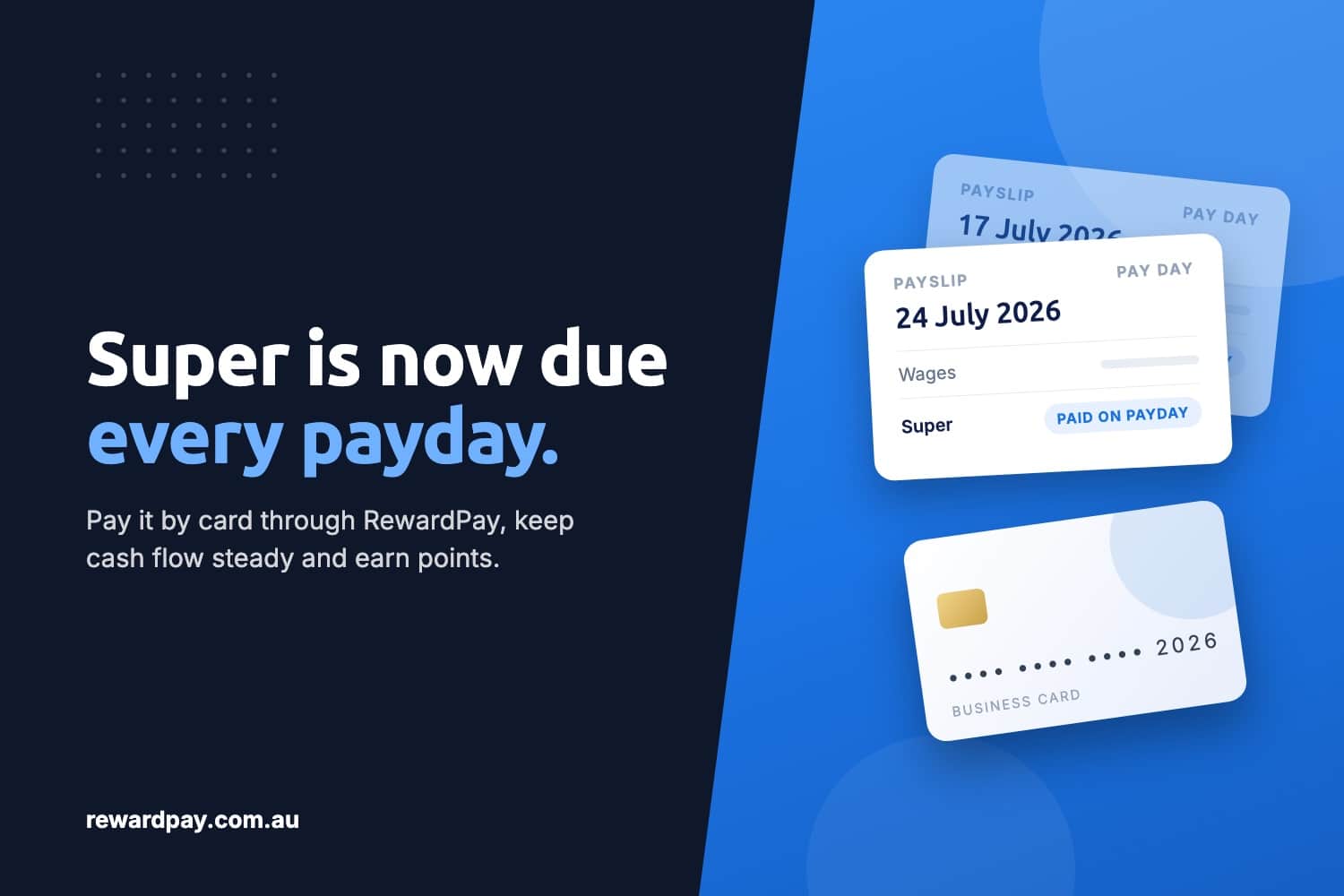
Since 1 July 2026, employers have had to pay super every payday instead of every quarter. For a business that pays staff weekly, that's 52 super payments a year instead of 4.
RewardPay can help. Pay your super by card through RewardPay to smooth out your cash flow, take advantage of your card’s interest-free days and earn points on a cost you have to pay anyway.
What is Payday Super?
Rule
What it means for you
Start date
1 July 2026
How often
Super is paid with wages, on every payday
Deadline
Contributions must reach each employee’s fund within 7 business days of payday
New starters or fund changes
Up to 20 business days for the first payment
What super is based on
12% of Qualifying Earnings (QE), reported through Single Touch Payroll each pay run
Late or short payments
The Super Guarantee Charge, which includes the shortfall, notional earnings and an admin uplift of up to 60%
ATO Small Business Superannuation Clearing House
Closed permanently on 1 July 2026
The key word is reach. The 7-day clock stops when the fund receives the money, not when you send it. So the time your clearing house and payment method take counts against your deadline.
Sources: ATO, Payday Super; AustralianSuper, Understanding Payday Super
The cash flow squeeze
Under the old quarterly system, super for a whole quarter could sit in your account for up to three months before it was due. Many businesses used that buffer to cover stock, wages or a slow month.
Payday Super removes that buffer. The money now leaves your account within days of each pay run, often in the same week as wages and other bills. For seasonal businesses, or those waiting on customer invoices, that can make cash tighter at exactly the wrong time.
How RewardPay helps
With RewardPay, you pay your super clearing house by card. We then pay the clearing house by bank transfer or BPAY, using the payment reference from your super run. Your clearing house splits the money across your employees’ funds as usual.
What you get:
Breathing room on cash flow. Super goes on your card, and you pay the card on its normal statement cycle. That can give you weeks of extra time, depending on your card’s interest-free period.
Points on every pay run. Choose to earn loyalty partner points on top of credit card points with each payment, for example Qantas Points when you link your RewardPay and Qantas Business Rewards accounts, Velocity Points when you link your Virgin Australia Business Flyer account, or ALL Accor points. You can choose one loyalty partner or all of them with every business payment.
Easy tracking. Every super payment sits in one place, with a receipt for each pay run.
No change for your employees or their funds. Your clearing house and the funds receive a normal payment.
How to pay super through RewardPay
Run payroll and prepare your super. Process your pay run in your payroll software and submit the super contributions to your clearing house as usual.
Get the payment details. Your clearing house gives you a payment reference (often called a PRN) and its BPAY or bank account details. Each super run usually has its own reference.
Log in to RewardPay. You’ll need your business’s ABN to sign up.
Add your clearing house as a payee. Enter its BPAY Biller Code, or its BSB and account number, exactly as your clearing house provides them.
Enter the amount and reference. Use the exact total and the payment reference for this super run, so the clearing house can match it.
Choose your card and confirm. Pay with Visa, Mastercard or American Express. RewardPay shows the fee before you confirm.
Keep the receipt. You’ll have a record of every super payment for your accountant and for the ATO.
Tips for staying on time
Pay on payday, not day 7. The deadline is when the fund receives the money. RewardPay, your clearing house and the fund each need processing time, so pay as soon as your super run is ready.
Don’t leave it to the last minute. Allow a few business days for the payment to reach your clearing house. RewardPay isn’t suited to late or overdue super.
Match the reference exactly. A wrong or reused payment reference can delay allocation and push you past the deadline.
Replaced the ATO clearing house? If you used the ATO’s Small Business Superannuation Clearing House, you’ll need a new clearing house, as it closed on 1 July 2026. Check that it accepts BPAY or bank transfer.
Frequently asked questions
Can I pay super and payroll through a card payment platform?
Yes. Most clearing houses only accept bank transfer or BPAY, but RewardPay lets you pay by card and pays the clearing house for you. You can pay payroll through RewardPay too.
When is super due under Payday Super?
Within 7 business days of payday. The deadline is when the money reaches each employee’s fund, not when you send it, so allow time for your clearing house and payment method.
Do my employees or their funds see anything different?
No. Your clearing house receives a normal payment and passes the contributions on to each fund.
Will I earn points?
Yes. Link RewardPay to Qantas Business Rewards to earn Qantas Points, or your Virgin Australia Business Flyer account for Velocity Points.
What happens if super arrives late?
You may have to pay the Super Guarantee Charge, which includes the shortfall, notional earnings and an admin uplift. That’s why it pays to send super as soon as each pay run is done.
What replaced the ATO Small Business Superannuation Clearing House?
Nothing directly. It closed permanently on 1 July 2026, so you’ll need a new clearing house. Many payroll software providers and super funds offer one. Check that it accepts BPAY or bank transfer, so you can pay it through RewardPay.
Are RewardPay fees tax deductible?
RewardPay fees may be tax deductible. Please check with your accountant for specific tax or accounting advice.
Make super work harder for your business
Payday Super means paying super more often, but it doesn’t have to squeeze your cash flow. Pay your next super run through RewardPay, keep cash in your business for longer and earn points along the way.
This article is general information only and isn’t tax, legal or financial advice. Payday Super details are current as at 30 October 2026; check the ATO for the latest rules.
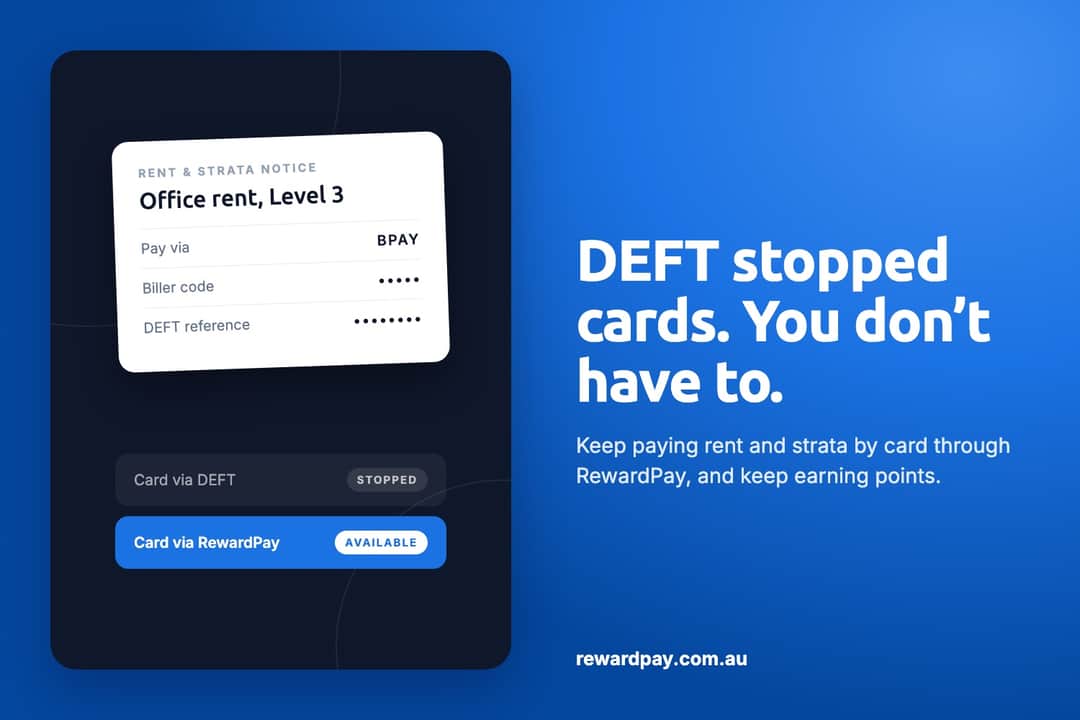
Since 1 October 2026, you can no longer pay a DEFT rent or strata notice with a credit or debit card on deft.com.au. For many businesses, that was the easiest way to put commercial rent and strata levies on a card and earn points.
Card surcharges end on 1 October 2026 for Visa, Mastercard and eftpos. See what changes, and what stays the same, if you pay business bills by card with RewardPay.
Signing up is free, takes around 5 minutes, and there are no setup fees or ongoing obligations. Click here to register. You will need your ABN, email address, and mobile number. When creating your password, make sure it is unique to RewardPay and stored somewhere safe. Once registered, check your email to verify your email address, then log in and complete a one-time identity verification. Once verified, your account is ready to start making payments and earning rewards.
RewardPay offers three subscription tiers. The Free tier has no platform fee and you only pay a processing fee per transaction. The Silver tier ($79/month) and Gold tier ($159/month) offer progressively lower Amex transaction rates, making them well suited to higher volume businesses. Visa, Mastercard and Bank payment fees are the same across all tiers. All platform fees are billed 3 months in advance and processing fees are a deductible business expense. See our full pricing breakdown here.
RewardPay supports payments to any Australian business with an active ABN – including suppliers, the ATO, superannuation clearing houses, rent, contractors, marketing, utilities, equipment and accounting. Payroll payments are also supported via Visa, Mastercard or Pay-by-Bank. Some restrictions apply – see the RewardPay Terms & Conditions for details.



 Still have questions? Chat with us.